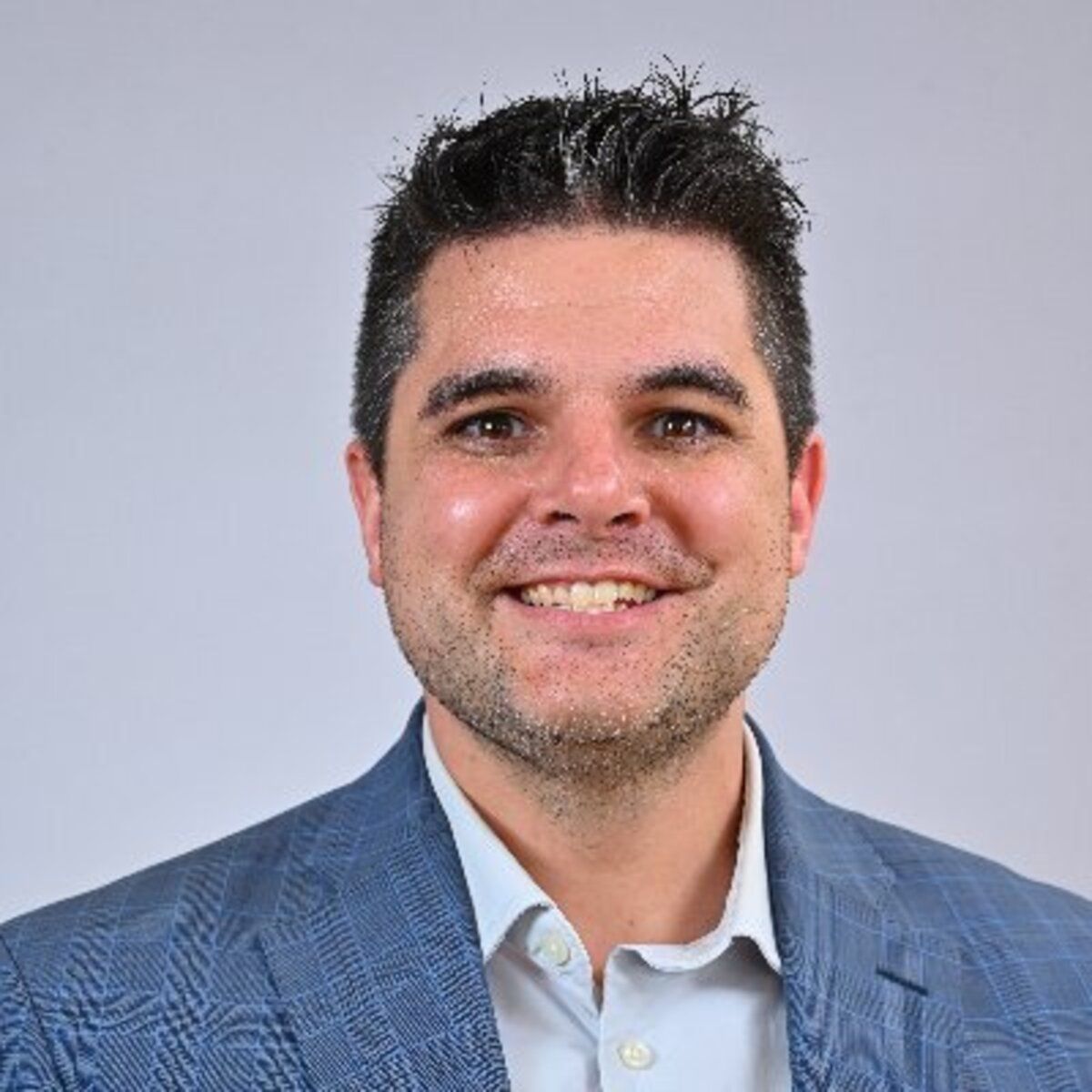
Good morning, and thanks for spending part of your day with Extra Points.
Today, we’re handing the mic over to KC Smurthwaite, who caught up with Metro Conference commissioner Travis Tellitocci, the man behind the league’s rebrand who finally dispensed with its acronym problem. KC, take it away …
The Metro Conference is building its own identity
by KC Smurthwaite
For years, the difference between the MAC and the MAAC could be found somewhere in the back of your throat.
MAC.
MAAAAC.
Hold onto the A for an extra beat, emphasizing that second one. Give it more of an ahhh. Maybe surrender and explain that you mean the one in the Northeast, not the one with football.
It usually worked, but not always.
Travis Tellitocci had one of those conversations before he even officially became commissioner of what was then the MAAAAC — that is, the Metro Atlantic Athletic Conference.
Tellitocci was working at the Ohio Valley Conference in Nashville in 2023 when, at a social event, someone asked why he was leaving town. He explained that he was moving to New Jersey to become commissioner of the MAAC.
The man he was speaking with said he had a connection to the conference: His son played football at Bowling Green. Of course he knew all about the MAC and MACtion.
“Well, no, it’s not that MAC,” Tellitocci remembered saying. “We don’t have football. We are a Division I league based in the Northeast.”
“That was the light bulb, I think, even before I stepped in this office,” he added.
Three years later, Tellitocci no longer has to explain which MAAC he runs. As of July 1, the Metro Atlantic Athletic Conference is renamed the Metro Conference, eliminating the acronym, the long A and the pronunciation gymnastics that came with it. Simplicity was the point.
Flag Football Is Here. Are You Ready?

Flag football is one of the fastest-growing sports in the world, and with its Olympic debut coming at the Los Angeles 2028 Games, new opportunities are emerging across the sport.
Join SMWW for a FREE live Doc Talk with Eastern University Head Coach Amanda Ruller to learn more about the future of flag football and how you can be part of it.
Ready to go further? SMWW’s Flag Football Leadership Course gives you the knowledge and connections to turn your passion for the game into opportunity.
The league formally announced the change in May after a multi-year process that grew out of the strategic planning initiative Tellitocci began after becoming commissioner. The conference sought input from university leaders, administrators, athletes, coaches, alums, fans and members of the media. A consultant working with the conference eventually put the change in terms that stuck with Tellitocci: Imagine having only 30 seconds to explain your conference.
“You spend the first 15 seconds telling people who you’re not instead of telling people who you are,” Tellitocci said. “Inevitably, you have to tell somebody: We’re not the MAAC that plays football. We’re not in the FBS. We’re in the Northeast, not the Midwest. We are the MAAC with two A’s.
“So we’re spending precious time telling people who we’re not instead of telling people who we are.”
Ultimately, Tellitocci and the conference landed on an identity intended to preserve its history while eliminating decades of confusion.
“When I first started this project, somebody mentioned that brand refreshes are overrated. It’s a little bit of a blip, and you move on,” Tellitocci said. “My response was, we have a name problem. It’s not just a rebrand. We actually have a problem that we need to solve.”
The league even made the confusion part of the rollout. Tellitocci joined Mid-American Conference commissioner Jon Steinbrecher, along with NACDA president and CEO Pat Manak, for a tongue-in-cheek video poking fun at the two conferences sharing essentially the same spoken acronym.
“We actually practiced that in the office so that I didn’t show up to Ohio and completely botch the whole thing,” he said, laughing.
“Kudos to those two for just having a good sense of humor and helping us out to really highlight a problem that was out there,” he added.
The Metro is made up of 13 private schools across New York, New Jersey, Connecticut, Massachusetts and Maryland. Ten are Catholic, and they all, Tellitocci believes, share similar missions, resources and approaches to athletics. They’re also close enough to one another that conference competition generally doesn’t require getting on an airplane.
Those characteristics became a clear part of the Metro’s identity during the strategic planning process. One phrase kept surfacing: “We just make sense,” Tellitocci said. “All like-minded institutions, all in a very good geographic proximity.”
That doesn’t mean Tellitocci has closed the door on future change. In an era when conference maps can become outdated overnight, he knows better.
“Never say never about anything in the world of conference realignment,” he said. “You have to be nimble.”

Waypoint is helping universities earn money from the travel spend of their fans and alumni with a free white label travel portal. Waypoint will launch and manage the site, at no cost to the schools, in a matter of weeks.
Schools like BYU, West Virginia and Georgia Southern are using Waypoint to drive new revenue for their athletic department.
The league has already experienced growth during his tenure. Merrimack and Sacred Heart joined in 2024, increasing membership to an all-time high. In 2025, the conference secured a multiyear extension with ESPN that puts more than 500 events annually on ESPN+ and the ESPN app, as well as select events on ESPN’s linear networks. Regional deals with SNY and NESN extended the league’s presence in major Northeast markets. In addition to that, Atlantic City received a five-year agreement for the men’s and women’s basketball championships. The league extended its golf championship relationship with Walt Disney World Resort and Arnold Palmer Golf Management. It also reached a three-year agreement to play its baseball championship at Heritage Financial Park in New York.
The pieces were accumulating. The league just needed an identity capable of carrying it beyond the Northeast Corridor. And Tellitocci knew from experience that a rebrand isn’t as simple as picking a font.
During 10 years working at his alma mater, Marist, he helped modernize the school’s Red Fox identity. That project required roughly three revisions. He needed a mascot, established colors and a defined campus identity as a starting point. The Metro, meanwhile, was a conference that spanned five states and 13 schools.
“I think we almost went 10, 11 rounds before we got to where we were,” he said. In the end, Tellitocci didn’t want a name that would be shortened to an acronym because, he said, “you’d be right back to the original problem, which some of those acronyms would have been 10 times worse than where we were at.”
The media members consulted during the process offered another reminder: “The media loves to shorten everything,” Tellitocci said. “So keep it short.”
The conference will retain its traditional red-and-blue foundation while reducing the five-color palette to two primary colors. The wordmark for the Metro was designed to work across everything from score bugs and television to apparel, digital platforms and championship signage.
But Tellitocci doesn’t view July 1 as the finish line.
“The actual rebranding project is finished,” he said. “The work to tell our story is just beginning.”
Three years in, the conference has checked off much of the infrastructure work Tellitocci wanted to accomplish, including the strategic plan, media rights agreement, championship extensions, membership growth and the rebrand. He’s established himself as a commissioner who leads by example; after championships conclude, he rolls banners himself so staff members can get out the door faster.
“The cleanup is done,” Tellitocci said. “It’s time to continue to be more strategic in how we do things. We have great momentum as a league and need to keep building.”
Or, as he put it another way: “Now it’s time to put our foot on the gas.”
And for the first time, the Metro can do it without spending half its introduction explaining how long to hold onto the “A.”


